




Sow the seeds of words within yourself,
and nurture them.
By reflecting one’s voice and behavior,
people can gain self-awareness and draw closer to one another.
Transforming those irreplaceable daily experiences into an asset that can be leveraged for the future.
Vision
Revolutionize Practice
Transform practice. Transform the future.
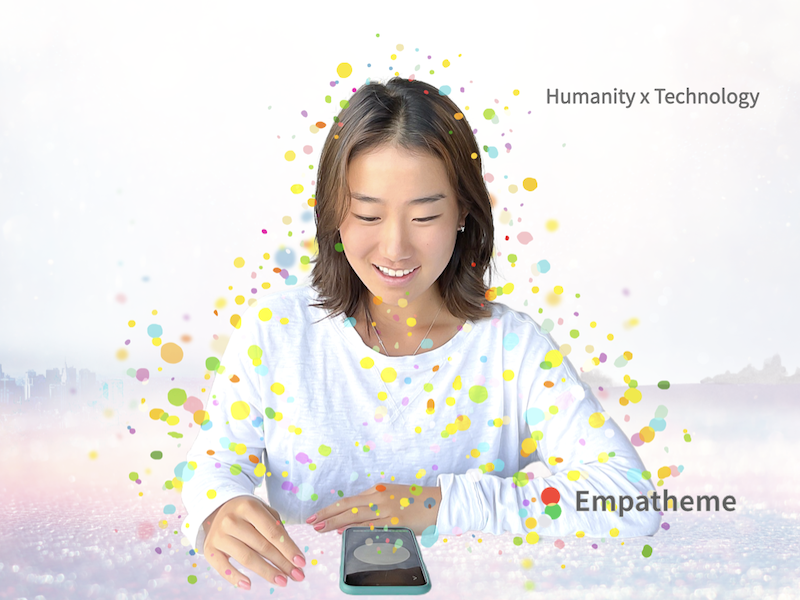
A “mirror” reflecting voice and behavior
Your voice and mannerisms reveal aspects of yourself you have not yet noticed.
You sow the seeds of words within yourself and nurture them.
In turn, that transformation manifests in your voice and behavior.
This system captures those manifestations and preserves them so they can be revisited later.
It allows you to look back and gain self-awareness.
And it enables others to connect with those insights.
That system is Empatheme®.
Purpose
Practice Infrastructure
Bringing practice infrastructure to society.
A mechanism for nurturing the inner self
Search engines and AI have made it possible to instantly access knowledge and answers. At the same time, however, the notion that “the correct answer lies outside oneself” has become increasingly prevalent.
Yet, there is a difference between being taught by others and realizing something for oneself. True insight arises from within.
People do not grow simply through external influence; we need practices that allow us to cultivate the roots of our own development from within.
We are working to spread a system throughout society that enables us to document our daily lives, gain personal insights, and share those insights in a way that fosters mutual connection and support.
Mission
Build The Practice Within
Cultivate a practice within yourself.
Helping Yourself × Helping Others
Sowing and nurturing the seeds of words within yourself.
Fostering self-help, self-awareness, and self-driven action.
We provide the technology and platforms to support your daily practice.
⚫︎ Empathy Interface®: A bridge between self-help and support
⚫︎ Empallet®: Connecting people through practice
⚫︎ Empatheme Lab™: A practice development program
Action①
English Ear° Trail | English Ear°
Practical Program for Real-Time Speech Recognition and Reproduction Capabilities
When you can see it, you notice the difference.
When you notice the difference, the way you hear changes.
When the way you hear changes, you change.
When you change, your world expands.
Develop your practice through “English Ear.”
Action②
Empathy Interface®
A platform connecting self-help and support
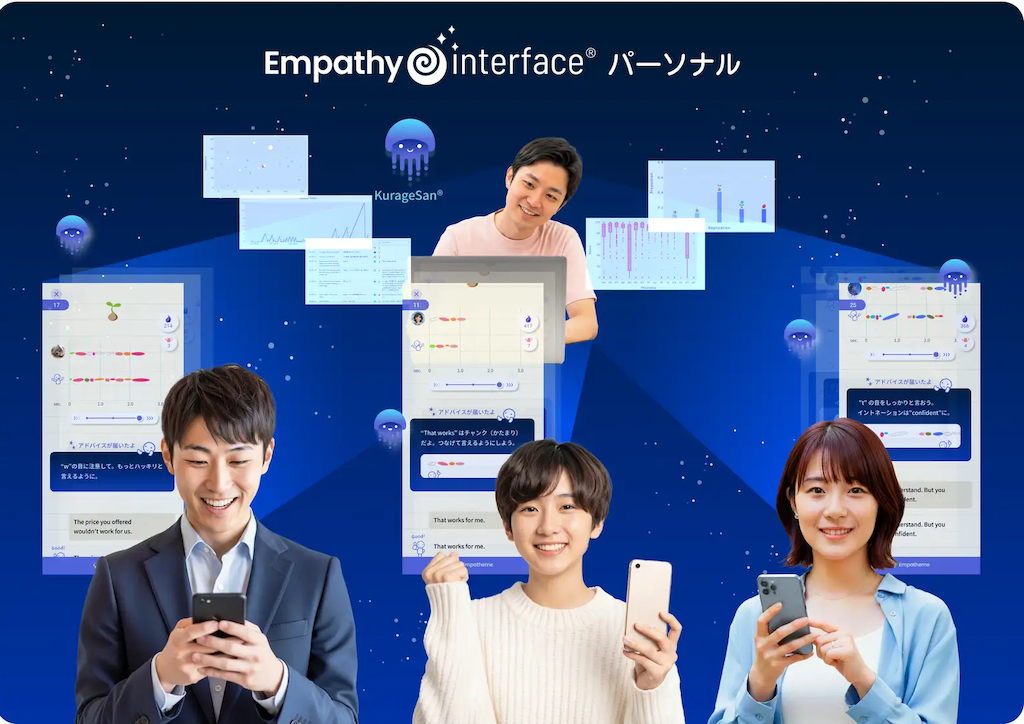
The results, the process, and the causes are visible.
We visualize not only results but also processes and underlying causes.
Practice data and Empathetic AI KurageSan® support those who provide care.
Everyone is unique; no two individuals are alike. By capturing each person’s specific context in the moment, we can truly stand by their side.
It is a platform for feedback and communication where people support one another.
Action③
Empallet™
A media platform connecting people through practice.
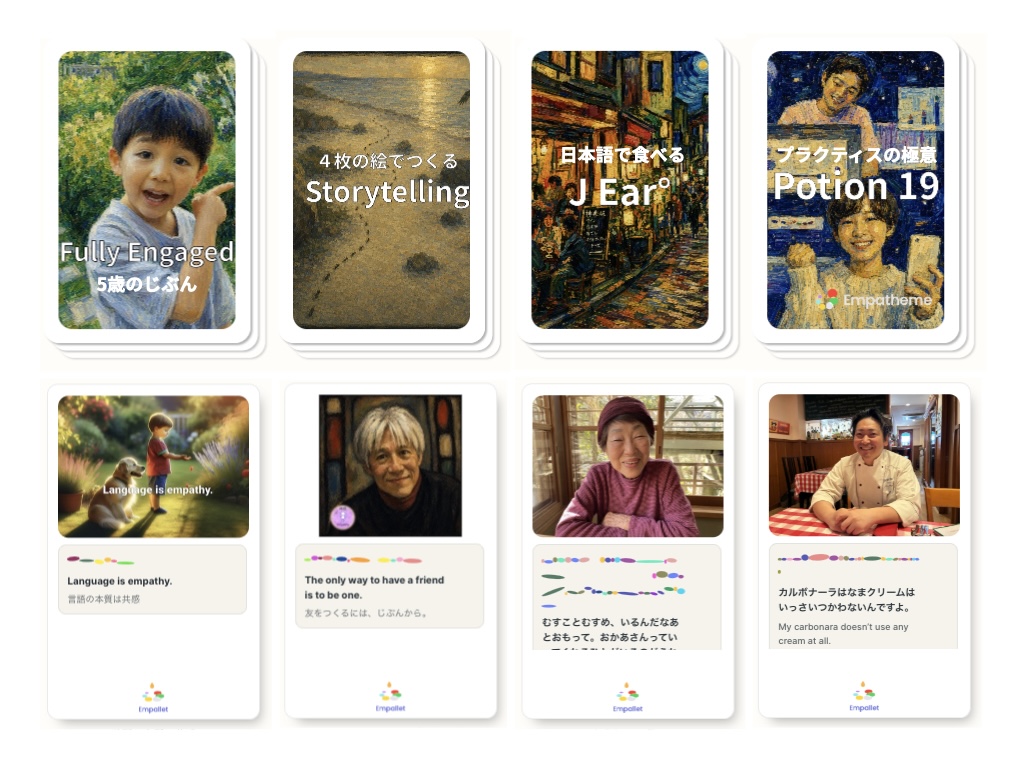
Preserving the irreplaceable
Transforming daily experiences into content through voice, images, and words.
Sharing experiences and cultivating context.
Creating new connections for records that had been buried.
Shaping moments so they can be revisited later and preserved for the future.
A media platform that connects people through practice.
Action④
Empatheme Lab™ Initiative
Empatheme Lab:
A Self-Driven Program for Personal Growth
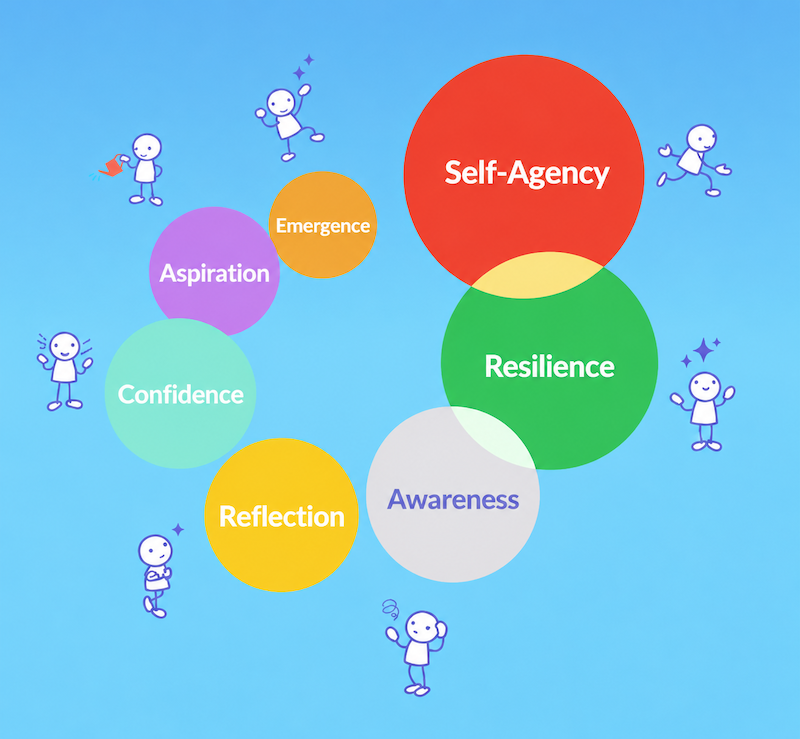
Building Your Practice Mechanism | SARUF
Results from others cannot be brought in from the outside. You create the cause within yourself.
◎ Self-Agency | The mechanism that moves you (S)
⚪︎ Aspiration | The capacity to turn yourself toward the unknown (A)
⚪︎ Resilience | The capacity to return to your usual self (R)
⚫︎ Unlearning | Reducing unseen habits (U)
⚫︎ First Things First | Creating the cause within (F)
SARUF is a practice model for cultivating these two capacities through a mechanism that turns every day. By practicing its two core principles in concrete ways, you gradually make them your own. The practice itself becomes evidence that you are cultivating the power to move yourself.
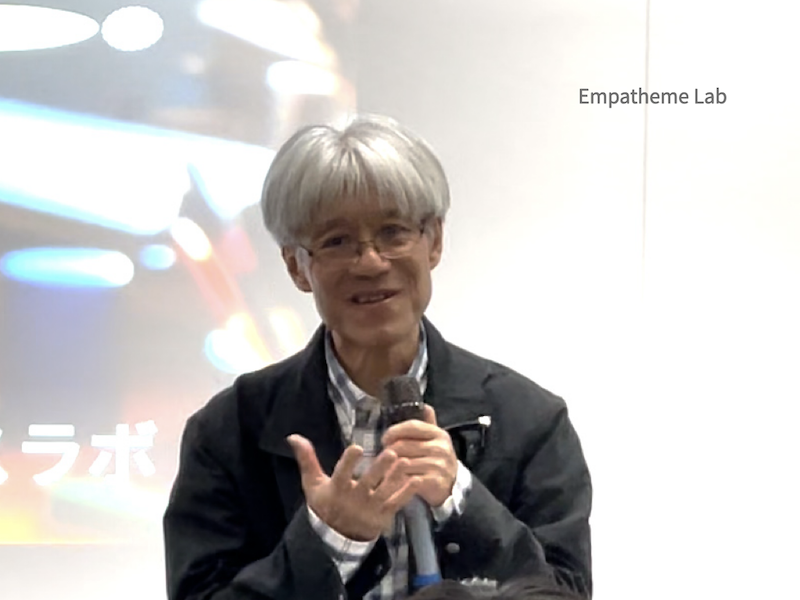
Cultivating from Within × Supporting from Outside
I, Tatsutaka Sakaguchi, arrived at SARUF through 40 years of multilingual practice in business, 15 years of development, research, and creative work, and more than 10,000 Empatheme practice sessions.
In that process, I discovered that few things reveal Unlearning and First Things First, Aspiration and Resilience, as clearly as acquiring a foreign language. Without them, one cannot truly develop ability; there is no detour around them. And to keep this process turning as daily practice without relying on willpower or grit, we need a mechanism that connects the inside and the outside. That mechanism is Self-Agency.
The practice of English Ear°—real-time speech recognition and reproduction—becomes evidence that you are practicing and acquiring SARUF.
Using Empatheme®, Empallet®, and Empathy Interface®, we connect invention technology, practice content, and data science, accompanying each person so they can turn their own practice cycle.
The origins and future of SomniQ
Creating a system that helps oneself and others through the power of voice.
I want to support self-agency efforts.
─A wish born from that
When I—Tatsutaka Sakaguchi (Representative Director and CEO)—was a teenager, my father suddenly became paralyzed on one side of his body and lost the ability to speak due to a speech disorder. Yet, apart from his inability to vocalize, his mind and spirit remained completely unchanged. For the more than five years until he passed away, he strove desperately to convey his thoughts—pointing to a hiragana chart, making slight hand movements, and using his breathing and gaze. I communicated with him relying on these signals, but I was tormented by a sense of helplessness at being unable to assist him as I wished. His voice existed within his brain, yet it remained invisible. “Live for the sake of others”—these final words he left me were sown like a seed within me; eventually, they took root in my heart and transformed into a deep desire to “make voices visible” and “support self-agency.”
Over the subsequent 25 years, I witnessed firsthand how technology transforms society—first through Sony’s overseas operations and corporate strategy, and later by leading mobile phone and smartphone development at Sony Ericsson. What I realized was that while the tools providing information and answers were multiplying, they alone could not unlock a person’s inner potential. What is needed is a system where individuals can become aware of their own voices and behaviors, and where others can stand by them in that process.
Meeting Hidenori Ishikawa (now CTO) transformed the wish I had carried since my experience with my father into the concept of “Empatheme.” Empatheme is a system built on proprietary technology that visualizes voice and behavior; it allows spoken words to be sown within oneself and nurtured through daily practice. I became convinced that this held the answer to the sense of helplessness I felt over being unable to save my father, and in 2012, I founded SomniQ in Silicon Valley.
A quest pursued since our founding
─People Cannot Be Grown from the Outside | A System for Cultivating the Inner Self
Since founding this company, I have explored—through both research and practice—what it truly means for a person to internalize something. In doing so, I have become convinced of a few things: being taught knowledge is different from truly making it one’s own, and being given an answer is different from realizing it for oneself. A realization is something that arises from within.
People do not change simply by being inspired. Even if they feel motivated in the moment, that alone does not translate into daily behavior. To truly internalize something, one must try it out, verify the results, notice the differences, and try again. This practice needs to become a self-sustaining cycle within the individual. At the same time, an external system is required to support that internal cycle.
However, day-to-day practices are largely invisible; they occur in the moment and then vanish. Individuals cannot directly observe their own voices or behaviors. Furthermore, the underlying reasons for why they sound or move the way they do lie within the brain—beyond the reach of either the individuals themselves or those supporting them. While it is possible to provide answers, it is extremely difficult to truly understand the specific obstacles a person faces or the nature of the changes they are undergoing. That is why we have developed a system to make these invisible practices visible, thereby fostering personal insight and facilitating effective support from others.
There is an innate human capacity that sustains this cycle: the voice. We take in words through our ears, nurture them within ourselves, and express them outwardly as voice. This process naturally reflects a person’s cognition, motor skills, ingrained habits, and daily changes. Precisely for this reason, by recording and comparing one’s voice and mannerisms—and being able to trace them over time—individuals can become aware of their own evolution.
This allows the person supporting the process to follow that same journey. You begin to see not only what the individual was unable to do, but also what they are starting to realize and how they are attempting to change. The supporter’s understanding aligns with the individual’s own realizations, and that interaction, in turn, paves the way for the individual’s next insight. It bridges the gap between a person helping themselves and one person helping another. This cycle lies at the very heart of Empatheme.
Achievements to Date
─Building the foundation for technology, practical application/demonstration, and services.
⚫︎ Inventions & Patents (2014–): Developed and patented five proprietary technologies, including speech visualization and behavioral feedback systems.
⚫︎ Japan Operations (2018–): Established SomniQ Inc. in Chiyoda Ward, Tokyo, and initiated business development and applied research.
⚫︎ Empirical Research (2019–): Published papers on the use of practice data; conducted classes and joint research with institutions such as Toyo University and Ritsumeikan University.
⚫︎ Development & Operations (2020–): Began in-house development and provision of learning systems, applications, and educational content.
⚫︎ Field Implementation (2025–): Demonstrated proficiency gains through a daily 10-minute practice routine at the English Science Lab of Chiyoda Junior & Senior High School.
⚫︎ Services (2026–): Launched “English Ear° Trail” and an educator dashboard; issued press releases. Unveiled Empathy Interface® and Empallet™; launched Empatheme Lab™.
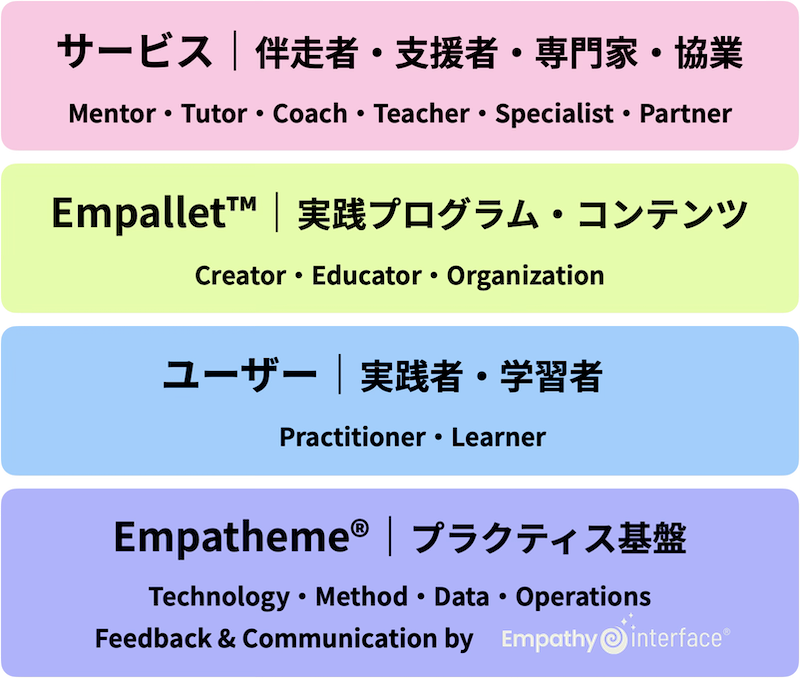
Bringing the infrastructure of practice to society
Empatheme—built upon this foundation—is a platform for practices that enable individuals to gain personal insights and then nurture those insights. By integrating practical programs, content, feedback, and support—all grounded in voice, behavior, and cognition—it fosters an environment where individuals can cultivate these practices within themselves.
We receive words through our ears, process them through our voices, reproduce them, and internalize them. This fundamental process remains the same, whether the language is English or Japanese. Consequently, this platform extends beyond mere language acquisition into a wide range of practices that nurture the inner self—including personal cultivation, creativity, mindfulness, leadership, and mental well-being.
We are introducing this platform to society as a space where diverse individuals and organizations—such as educators, creators, support providers, experts, schools, and companies—can participate, create, and develop their own practical programs, content, and support services.
Our Purpose and Mission are to cultivate an environment where practitioners, creators, and supporters connect through Empatheme as a shared foundation, giving rise to a continuous stream of new practices.
Discovering for yourself, nurturing your inner self.
─Why did I start with the “English Ear” Trail?
The process of realization reveals itself in voice and behavior.
Language acquisition is one specific area where the potential of the Empatheme platform has become clearly apparent. In particular, the process of a native Japanese speaker acquiring English reveals challenges that only become visible when one traces the interplay of voice, cognition, and behavior. At the same time, this process—where individuals gain internal insights and transform through practice—manifests vividly in the voice itself.
The “English Ear° Trail” program builds a foundational ability to capture sounds entering the ear in real-time and reproduce them with one’s own voice. By personally verifying differences in how sounds are heard and how the voice is produced, learners uncover habits and preconceptions they were previously unaware of. They then use these insights to try again. By repeating this small cycle daily, learners cultivate a system of self-help, self-awareness, and self-driven progress within themselves through actual practice.
It is also crucial to be able to track this process and its results. The program makes visible what the learner realizes, how they change, and how they sustain their efforts. It allows those providing support to recognize these changes and offer better guidance. Through the mastery of the fundamentals—real-time auditory perception and vocal reproduction—the English Ear° Trail serves as a program that concretely implements Empatheme’s vision of a system for “self-realization and internal growth” while demonstrating the tangible results of that process.
What I am doing firsthand
“English Ear° Trail” is a program I designed, developed, and created based on years of personal practice—a process I continue to refine through my own daily routine. At Empatheme Lab™, I use this program and the “Empatheme” method to support individuals—from junior high and high school students to working professionals—in cultivating self-reliance, self-awareness, and the ability to drive their own progress.
This work is grounded in my own experience living abroad and using multiple languages over the past four decades. I have been active in business and educational settings using both English and Spanish. In English specifically, I have engaged in research, development, and creative work, delivering over 3,000 presentations and speeches and participating in tens of thousands of meetings, negotiations, and conversations. I have also listened closely to the English voices of more than 2,000 Japanese speakers.
Furthermore, over the last seven years, I have supported the practice routines of over 1,000 individuals—ranging from students to professionals—through instruction and services provided at the lab. Through the data gathered and what I have witnessed firsthand, I have come to a stark realization: a pervasive misconception—shared by both learners and teachers—that the “method to become proficient” can simply be acquired from the outside is obscuring the very practice of mastering the skill for oneself.
People often attempt complex, difficult tasks without first mastering simple, fundamental exercises. That is the root of the problem. What is needed is not a rush to achieve results, but the adoption of a daily loop of small practices: listening, imitating, verifying, and reflecting. My primary mission is to focus on this process and guide individuals toward the experience of trying something themselves and succeeding.
The Missing Practice
“Trying it out and succeeding” means imitating the sounds you hear using your own voice. When you do this, you encounter the sounds and rhythms of Japanese that you have unconsciously internalized. You also realize that you had been memorizing words by reading them and pronouncing them in your own way. Yet, with even a little repetition, you improve.
Fundamentally, language is acquired through the voice. Young children learn language by reproducing the sounds they hear with their own voices and repeating them daily until they are imprinted on the brain. The same applies to English; there is no other way to master it than by listening, imitating, acting it out, and practicing through daily repetition.
However, this very element of “practice” is missing from English learning in Japan. Of course, there is no shortage of teaching materials, schools, and services. Learning is often driven by test scores, yet the focus remains on the results rather than the process of daily practice.
Neither the learners themselves nor those supporting them can see where the stumbling blocks lie, what insights are gained, or how the momentum is maintained. Without understanding the root causes of why they cannot hear certain sounds or articulate words correctly, it becomes difficult to establish a habit of even ten minutes of daily practice. The fundamental issue lies deeper than any of these specific hurdles: there is simply no system in place for a practice cycle where learners engage with the material, keep a record of their efforts, compare results, gain insights, and apply those lessons to the next step.
Videos of native speakers, explanations from instructors, advice from coaches, AI-driven improvement strategies—there is already an abundance of knowledge available. Yet, these all represent the results achieved by others; one cannot simply mimic someone else’s outcome. What is truly needed is to internalize the process itself—to master the mechanics of how you practice and acquire the language, understanding the underlying causes and the steps involved in your own personal practice.
A System for Awareness and Support
Traditional English learning has focused on imparting knowledge, providing materials, and preparing for tests. However, that misses the core of the matter. While “what to learn” and “how to teach” have evolved, the question of “how to internalize the language” has largely been overlooked. There has never been a system designed to sow spoken language within oneself, nurture it through daily practice, and trace the causes and processes that lead to improvement and sustained effort. Just as one cannot run before walking, there is a specific order to acquiring a language. The starting point for everything is to build a foundation—much like how young children acquire language—by listening, imitating, and repeating.
“English Ear° Trail” is a system that translates this concept into concrete daily English practice. It is neither merely a set of teaching materials nor just a standard learning course. It involves a routine—like brushing your teeth—where you spend ten minutes a day listening to, imitating, and verifying short lines of dialogue that last no more than two seconds. Just as a game of catch requires a ball that can be thrown and reached, practice is ineffective if the material is too long to hear or speak properly. The scenarios, lines, audio, and volume of practice are quantitatively designed to ensure that these brief exercises are repeated naturally.
English Ear° Trail cultivates the foundation for internalizing spoken English. By vocalizing the language, you imprint it onto both your brain and body; the practice itself becomes a daily habit, fostering both improvement and continuity.
Furthermore, we use data science to analyze the practice sessions, tracking everything from the mindset right before taking the first step to the flow of the exercise itself—going beyond mere final results. This approach visualizes the causes and processes behind improvement and continuity, enabling learners to gain their own insights. When learners cannot identify these insights on their own, they can consult tutors or mentors for advice. These tutors and mentors trace the learner’s practice process via the “Empathy Interface®” and, supported by the “Empathetic AI KurageSan®,” provide personalized feedback tailored to each individual.
Through this ongoing practice, we have also begun to understand how these moments of insight occur. The individual senses that “something is different.” Those providing support notice this realization and offer feedback only where it is needed. This interaction, in turn, sparks the individual’s next realization. Rather than imposing answers from the outside, the support system evolves based on the insights that emerge from within the individual.
AI supports tutors and mentors, who in turn support the individuals. By connecting previously invisible practices with the individual’s own insights and the support of others, we have created a system that fosters progress and sustained engagement tailored to each person’s unique path.
Truly, sow the seeds of your voice and nurture them.
There is a special joy in finally understanding what someone is saying—in the moment when words that once eluded you suddenly become clear. We have witnessed this joy time and again through the practice of the “English Ear° Trail.”
Humans possess an innate ability to internally reproduce the sounds they hear and then recreate them with their own voices. We acquire language by harnessing this very power. As you repeat the “ear-to-voice” exercises of the English Ear° Trail, your capacity to reproduce sounds expands, allowing you to hear nuances you previously missed. You can experience this transformation firsthand.
Being able to understand English brings joy; being able to speak it is fun; and mastering it builds confidence. These experiences are truly invaluable. It begins with sowing the seeds of spoken words within yourself and nurturing them through small, daily cycles of practice. The power of this process is immense. Through repetition, those seeds grow into a strength that supports not only you but others as well. This experience lies at the very heart of my own journey.
“Empatheme” transforms this concept of the “voice seed” from a mere metaphor into a tangible system. It visualizes the spoken words you perform—breaking them down into individual lines—and preserves them as practice data. At the same time, this creates content that you can revisit later. The English Ear° Trail is the practical application of this system in your daily routine. Every time you speak aloud, you are recording your practice, cultivating new insights, and creating an unexpected treasure for your future self.
Accumulating practice means preserving your spoken words. The ability to look back on that voice and the process behind it becomes an invaluable asset for each individual. I have experienced this firsthand. For over forty years, I have listened to, performed, conveyed, recorded, and practiced spoken language. Furthermore, for more than a decade, I have used Empatheme to preserve these practices as a traceable record, repeatedly refining them and cultivating them into a usable form. The goal of the “English Ear° Trail” extends beyond merely achieving proficiency in English. It is about trying things for yourself, noticing differences on your own, and persisting through your own efforts to master a skill. By repeating this small cycle daily, you cultivate the capacity for self-reliance, self-awareness, and self-driven progress within yourself. And when you encounter moments where you cannot see the path forward alone, others walk alongside you, tracing that same process. This fosters insights for both the learner and the supporter, allowing the practice itself to grow.
The English Ear° Trail represents the first step in this endeavor. We aim to expand the practices cultivated through English—such as real-time auditory recognition and vocal reproduction, systems that reflect one’s voice and behavior, and the interplay between insight and support—to Japanese and a wide range of other languages. Receiving language as sound, nurturing it within, and conveying it to others through one’s own voice: through this process, we empower each individual to help themselves and, in turn, help others.
We sow the seeds of voice and nurture them from within. We are committed to spreading this practice throughout society.

Company Profile
Company Name: SomniQ, Inc.
Incorporation: Delaware C-Corp (Headquartered in California)
Founder & CEO: Rikko Sakaguchi
Business Domain: Learning Platform Services, Content Creation, Technology Research & Development, and Collaborative Partnerships
Founded: November 9, 2012
Overview
SomniQ is a Silicon Valley venture with research activities in the United States and Japan. For over 13 years, we have combined science and the liberal arts, putting humanity and technology at the core of our innovation. Founded in Menlo Park in 2012, SomniQ built a strong R&D foundation before the AI era, creating a portfolio of co-creative method patents—including context feedback, dynamic speech visualization, stationary-state interfaces, empathic response systems, and affordance design.
Technology and IP
Our principal technology is Empathy🌀Interface®, a human–AI co-creative practice system built around our patented Hearing Mirror®, Rhythm Mirror®, and Context Mirror®. These tools are designed to visualize and nurture human practice.
Product and Service
In 2018, we began service development in Japan, bringing our technologies from research into real-world applications. This year, we launched English Ear° Trail—a platform that helps learners and educators build daily practice routines and experience English sounds and rhythm in new ways. Our products provide real-time and continuous feedback to encourage consistent, joyful learning.
Vision and Purpose
With Empatheme, practice becomes a living medium for the dynamic interplay of self-agency and empathetic agency. As people practice, their actions, timing, and presence become shared assets, fostering mutual learning and social innovation—and advancing co-creative AI.
Mission
SomniQ seeks to lead this new ecology, where practice becomes culture and media itself becomes practice. Built on unique technology, IP, and the power of shared and accumulated practice data, we aim to set a new foundation for learning, content, and value creation through co-creative human–AI practice.