
Profile

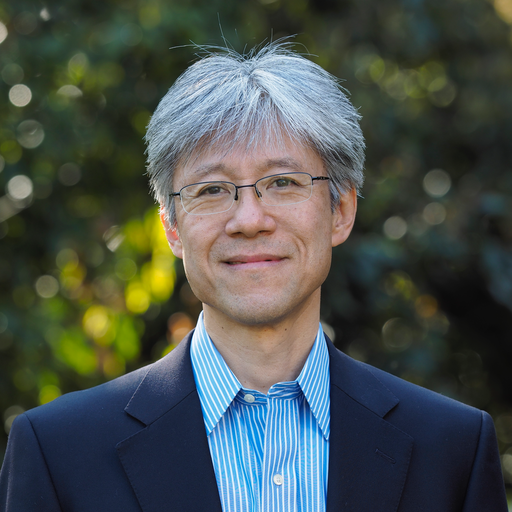
Rikko Sakaguchi
Born in Fukuoka Prefecture in 1963. Now based in Tokyo after 36 years abroad, Rikko has lived, studied, and worked in Mexico and Spain (10 years), Sweden (10 years), and the United States (16 years).
Founded SomniQ, Inc. (US) in 2012 and SomniQ Co., Ltd. (Japan) in 2018. Founder & CEO.
From 2002 to 2011, he served at Sony Ericsson Mobile Communications (Sweden) as Executive Vice President & Chief Creation Officer, leading global company-wide development and the mobile phone/smartphone business, with 600 million units shipped.
Be the change you wish to see in the world!
He is currently engaged in the research, development, and practice of Empatheme, a practice platform that helps people notice themselves and enables others to support that awareness. By connecting science, language, liberal arts inquiry, invention and patents, data science, and decades of multilingual practice, he is building a system that makes voice and behavior traceable after the fact, nurturing self-agency, self-awareness, and self-driven practice.
Essays and Inquiry
Creative Works / Writings
Creator of English Ear° Trail®
The Origin of Empatheme
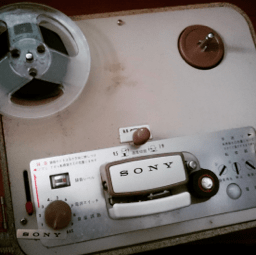
The idea behind Empatheme goes back to a “magic box” Rikko encountered at the age of four: a Sony tape deck his father brought home. The first time he heard his recorded voice, he felt an unforgettable shock: “I’m in there!” That memory remains vivid to this day. From then on, using English tapes his father had through work, he played by imitating sounds, recording his own voice, and listening back. This became the origin of his “English ear” and the seed of the Empatheme concept. Looking back now, it was practice itself: doing it oneself, and noticing for oneself.
At sixteen, he went to the United States and entered a local school one grade ahead. He expected to continue on to university and graduate school in America. It was a path opened by his father’s teaching and tireless support. But from the day his father collapsed, that path was gone. His father became hemiplegic and developed dysarthria, a condition that made it impossible for him to produce speech. His brain was intact, but he could no longer give voice to words. The voice of language was present inside his mind, yet invisible. During the long years until his father passed away, they communicated through a hiragana letter board, relying on hands, breath, and gaze. Rikko was tormented by the helplessness of being unable to support his father’s efforts toward self-agency as fully as he wished. His own sense of loss over a closed path also remained. Yet through these exchanges, he came to understand that his voice was being reproduced in his father’s brain. He realized that subtle gestures and faint signs before speech can carry meaning deeper than words. This, too, was something he learned during those days.
Around that time, he joined Sony. On his first day, by order of the chairman, he was assigned to a year of simultaneous-interpreting training. While carrying out his daily work, he underwent training that pushed the brain’s processing and memory capacity to the limit. “Listening” is a one-time, now-or-never event: the brain recreates sounds that vanish instantly. “Speaking” is also a one-time event that happens anew each time. Reading and writing, by contrast, are not bound by the same real-time constraints and can be revised again and again. Through this experience, he encountered a simple but exacting truth: acquiring language means repeatedly practicing those one-time moments.
Words do not become a voice simply by acquiring knowledge. We listen, imitate, give voice, and listen again. By practicing those one-time moments over and over, language gradually takes root within us. Through more than 40 years of work in English and Spanish, and through supporting many people in developing their English voice, he has continued to confirm this principle.
Twenty years later, he was leading smartphone development. Technology is a system in which input produces output. Yet people cannot input what they have not noticed. Likewise, technology and computers cannot produce output without explicit input. This is a limitation shared by human beings and technology.
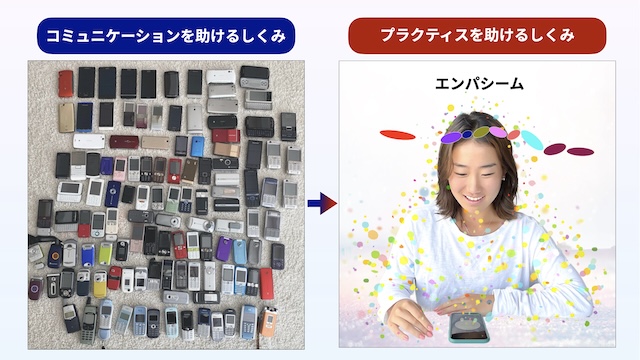
How, then, can we notice our own behavior when we are not yet aware of it? This question is the origin of Rikko’s inquiry and the founding vision of SomniQ. Many people wish to improve, yet cannot see how their own behavior may be holding that improvement back. That is why we need a “mirror” that helps us reflect on ourselves and notice.
The clue came from a phrase his father spoke from his sickbed: “Keitan Eichoku” — if the form is right, the shadow appears straight. “Form,” or behavior, appears as “shadow,” or data. But one cannot create the shadow alone. True to this phrase, if we can create a system that reflects the form of one’s practice as a shadow, we can use it to help one another. Everything appears in the situation, inner process, and history of an action — in its context.
The Purpose of Empatheme
In 2012, Rikko founded SomniQ together with Hidenori Ishikawa. Since then, they have continued to search through trial and error for a way to truly reflect people back, like a mirror. This is not a metaphorical mirror, but a challenge to turn the human voice and behavior into reproducible data, reflect it back, and help people notice. The result is Empatheme®, an empathetic system that supports practice. By “empathetic,” we mean a system in which humans and AI can exchange not only explicit interactions, but also implicit contextual cues — prompts — that express the situation.
Unless the situation in which words arise is shared, AI cannot be truly helpful in a personal and caring way. Nor can people open themselves to AI, ask questions, or teach it. AI is highly powerful in tasks where requirements and intentions are conveyed through explicit language. Yet it cannot easily create casual, natural exchanges with people. That is because interaction is not a problem of AI alone; it is a mutual process between human beings and AI. AI has no posture, facial expression, or gesture, and people have no natural means of conveying their own posture, expression, or gesture to AI. That is why technology that enables shared contact, context creation, and context sharing is essential. But technology alone is not enough. Empatheme’s Purpose is to approach this from both sides — human insight and discovery, and system design and invention — and to provide an actual environment for practice.
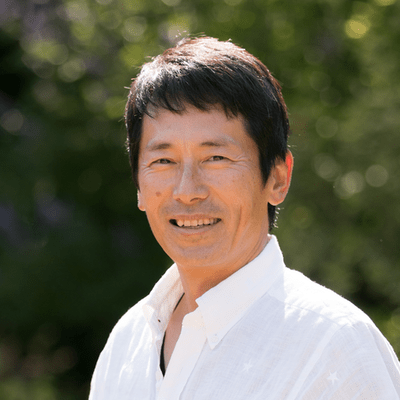
Hidenori Ishikawa
Born in Hiroshima Prefecture in 1970.
Based in Palo Alto, California.
SomniQ CTO
Engineer and entrepreneur
2025– Visiting Professor, Ritsumeikan University
2012– SomniQ CTO, leading invention, research and development, production, and service operations
Before 2012: responsible for technology strategy at Sony Ericsson and Sony
He has been involved in technology development and market introduction across the spectrum from semiconductor fundamentals to product applications, driving the commercialization of new technologies and products.
Activities
He is currently advancing the commercialization of an English program that applies Empatheme technology as co-creative AI. At the center of this work is the Empatheme Lab, where research, development, and demonstration activities are underway. He is leading the development of a platform that supports English learners using Empatheme data, with the goal of establishing a new method of learning support that draws on Empatheme data woven from the subtle edges of human unconscious behavior.
To date, he has aimed to open new fields of research by integrating Empatheme technology with psychology, neuroscience, phonetics, and the science of learning and habit formation.
In joint research with Toyo University, SomniQ conducted empirical studies of Empatheme alongside the development of classroom practice, achieving results including the acceptance of a paper in the Journal of Japanese Society for Engineering Education. In 2023, he published a paper discussing the possibility of supporting learners in second-language acquisition by visualizing and analyzing data that had previously been difficult to capture through Empatheme.
He is currently collaborating with a robotics laboratory at Ritsumeikan University to study the relationship between human behavior, biosignals, and Empatheme data.
Through these research activities, we aim not only to advance technology, but to create new experiences through which people can face their unconscious processes and tune the mind. I believe that if people around the world can experience even brief moments of inner calm, such a system can contribute to a more peaceful society. We continue our research and development every day to demonstrate that Empatheme can create those moments in concrete and practical ways.