


Press Release: SomniQ
November 25, 2025, 13:00 JST
Visualizing Cognitive Processes: Human × AI Evolving Learning System Empatheme English Ear° Trail® Released
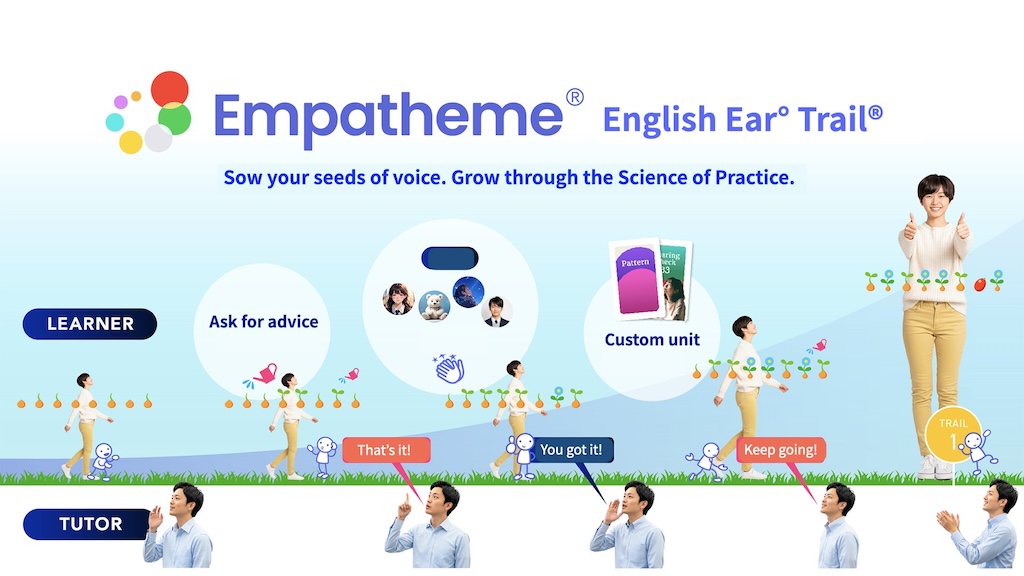
SomniQ Inc. (Chiyoda-ku, Tokyo; CEO: Rikko Sakaguchi) announces the release of Empatheme English Ear° Trail®, a new English-learning system that unites an app and a dashboard to create a truly co-creative, evolving learning experience between humans and AI.
Designed for English learners and those who support them, the patented Empathy🌀Interface®” bridges the app and dashboard, creating a collaborative space where learners’ daily practice meets educators’ and supporters’ real-time guidance. With researchers also able to participate, Empatheme English Ear° Trail® provides an innovative infrastructure for learners, teachers, supporters, and researchers to advance language learning together.
The system visualizes cognition and practice, deepening real-time engagement and accelerating language acquisition for everyone involved in English learning.
【Background】Empatheme® – Visualizing Cognition, Complementing AI, and Enabling Co-Creation
We now live in an era where much of our daily life—and even our thinking—unfolds on the screens of smartphones and PCs, deeply intertwined with AI-driven interactions. As convenience accelerates, our essential human capacities—cultivating inner strength, exercising self-agency, and learning independently—are quietly eroding.
At the core of all learning lie cognitive processes, subtle internal bodily movements, and everyday behaviors—elements fundamentally invisible to the eye. The clearest example is spoken communication: the deeply personal act of listening and speaking with one’s own voice.
Language isn’t something that can be taught; it truly takes root only through one’s own embodied practice—through the lived, resonant act of doing. This is the key to learning, and it’s the point where true resonance—real growth—happens. In this hybrid landscape, both human experience and AI interaction must harmonize to support authentic learning.
Breaking the Bottleneck: Revealing Invisible Cognition in Learning
If we cannot capture these invisible cognitive processes and subtle internal movements, the growth of learners, the support educators can provide, and the potential for learning research are all severely constrained.
That’s why we need a new learning infrastructure—one that:
- Visualizes these inner processes like a mirror
- Shapes them into usable units for practice and analysis
Systematizes them into a co-creative framework that allows us to trace causes and effects, supporting genuine inner awareness
At SomniQ, we have taken on the unprecedented challenge of making invisible cognition visible, head-on:
- So learners can gain tangible results through daily practice
- So educators can encourage, prompt awareness, and support learners more closely
- So researchers can leverage rich practice data to advance the science of learning
Drawing on patented technologies from 13 years of R&D and empirical work in Silicon Valley, we go beyond AI systems limited to external frameworks, opening the door to a next-generation learning system that fosters awareness from within.
Nowhere is this visualization of cognition more powerful than in language practice—listening and speaking.
Empatheme English Ear° Trail®
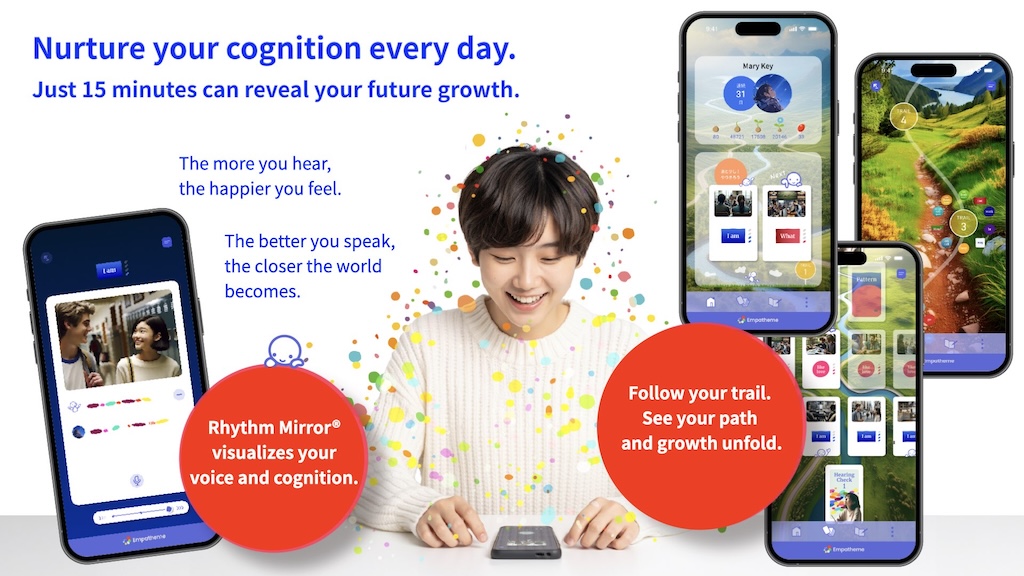
The Reality of “Invisible Practice”
You cannot observe your own practice from the outside.
How are you hearing right now? What kind of voice are you producing? Are you doing it well?
Neither the learner nor the teacher can truly know, because whatever happens inside the learner’s mind is invisible.
Language happens on the inside.
The brain’s cognitive processes and the fine movements inside the mouth are hidden from view—beyond what external observation can capture.
“Listening” is not merely taking in sound through your ears; it is the act of replicating that voice as an internal representation in your mind.
“Speaking” is the instant retrieval of that internal replication and its release as sound.
Listening and speaking are two sides of the same coin—one unified, invisible cognitive act.
Why External Teaching Alone Cannot Bring Change
The voice you produce disappears the moment it leaves your mouth. Most of the time, you are unaware of how you are actually creating sound.
That is why external teaching alone cannot generate real change in your inner cognition.
The reason why learners
— “cannot do it the way they were taught,”
— or “keep being taught but are not actually practicing,”
— or fail to notice the gap altogether,
All comes down to a single cause:
Because they cannot see their own practice.
“What did you just say?”
If you could visualize your own cognitive process, that fleeting moment of “something feels off” would become clear.
English Ear° Trail® reflects this invisible cognition onto a mirror on your smartphone, transforming your practice into visible practice—something you can finally see, understand, and improve
Nurturing Seeds by Replicating Lines
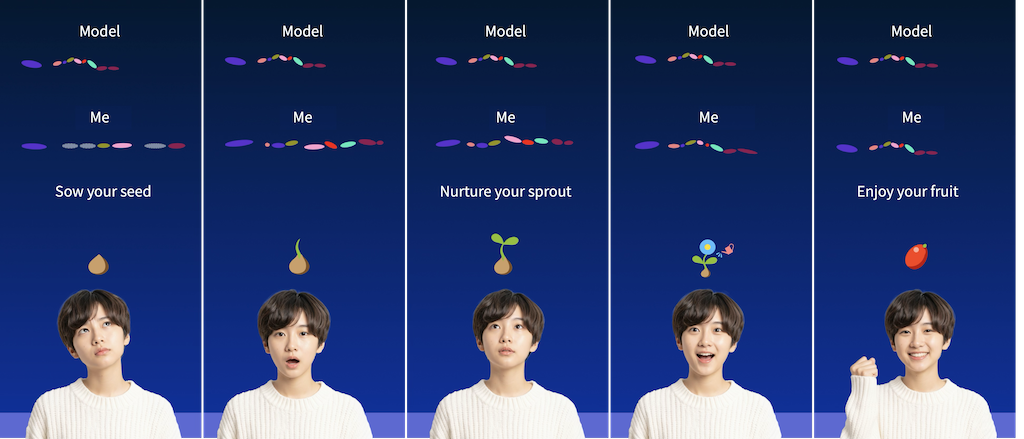
Hear and Replicate ▶︎ Replicate and Perform ▶︎ Perform and Verify ▶︎ Compare and Notice
The essence of practice is simple: imitate the model lines as closely as you can.
But real practice is not just listening and repeating once. To grow, you must listen to your own voice, visualize it, check it in real time, and compare it with the model, asking yourself:
Where is it similar?
Where is it different?
This cycle of internal awareness helps you recognize and reduce your habitual patterns, leading to steady improvement and closer alignment with the model.
Practicing Through Sound and Rhythm Visualization—Not Studying or Memorizing Text
In English Ear° Trail®, we use a replication model: how closely you can replicate simple lines of speech.
Based on this, your growth in reproducing lines becomes clearly visible.
You sow lines of spoken words as Seeds—with your own voice—and nurture those Seeds as they appear on the Rhythm Mirror®, taking shape through sound, rhythm, and your evolving replication.
English Ear° Trail® Release Commemorative Campaign

To commemorate the release of English Ear° Trail®, we are offering in-app practice content free of charge for a limited time.
Try it with your own voice!
▼ Join / Download here
Three “Mirrors” that Visualize Practice, and the Empa-Journal
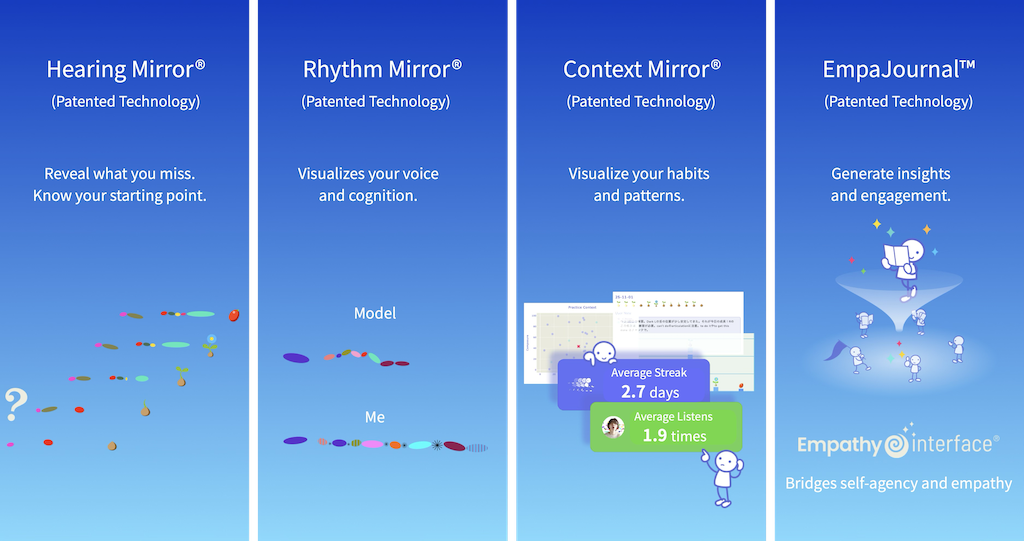
The English Ear° Trail® app and dashboard are built around three patented Mirrors that make your Practice visible, along with an Empa-Journal that deepens reflection and inner awareness.
・Hearing Mirror® (Patented Technology)
Listen to the model line and replicate it inside your mind by transcribing what you hear.
This reveals which sounds you truly perceive and which you miss—making your normally invisible sound perception observable, measurable, and correctable, far beyond guess-based listening.
・Rhythm Mirror® (Patented Technology)
Visualizes rhythm, articulation, tempo, intonation, and pronunciation. Your voice is reflected syllable by syllable in real time, allowing you to instantly see your recordings, A/B comparisons with the model, and progress over time.
It turns your spoken lines into visible data you can grow from.
・Context Mirror® (Patented Technology)
Captures the context of your practice—your habits, frequency, continuity, speaking patterns, and emotional/behavioral cues.- what led to growth, what caused breakdown, how your daily actions create change. This makes previously invisible factors and growth clearly visible, including causes and effects.
・Empa-Journal™
A reflective journal for feedback, inner questioning, and realizations. It automatically gathers your daily Practice evidence into a clear record for reflection, meta-cognition, and communication.
The Empa-Journal also serves as a shared space where learners and Educators connect, support, and co-create growth.
Practice Trails – A Unique Content Design
The “Trail” is a pathway where the structure and direction of improvement become visible—and where you can trace your growth over time. Its key features include:
- Card-style UI with a real-time Rhythm Mirror®
- Themed cards that combine scene visuals with two-second dialogue lines
- A unit structure designed for effective repetition in just 15 minutes a day, maximizing Practice density
- Quantitative design covering over 90% of high-frequency items in everyday conversation corpora
- “Potion” content—a systematized set of practice insights that guide improvement
The Key to Improvement Lies Within You

Improvement is not about adding more knowledge.
It is about changing your internal cognitive circuitry.
Each 15-minute session helps you let go of one self-imposed habit at a time.
As the grip of Japanese sounds and rhythms loosens, inner Cognition gradually shifts.
Small subtractions accumulate—and eventually grow into lasting transformation.
English Ear° Trail® visualizes and shapes your trajectory of Change.
You can view an example of Seed growth on the Empatheme website through the true story of Ray’s development.
Empathy🌀Interface® – Bridging Self-Agency and Empathy
Empathetic Agency — The Human Principle Behind the Empathy Interface
Language learning is, at its core, an act of self-agency. Neither teachers nor AI can learn on the learner’s behalf. The fundamental transformation—changes in perception, rhythm, and movement—can only arise through the learner’s own embodied practice.
This truth is so fundamental that it is often overlooked: AI cannot do it for you, and a teacher cannot become the learner in your place. Meaningful progress occurs only when learners exercise self-agency and engage in daily practice through their own voice.
To support someone else’s self-agency is to help activate it—so that real practice happens today, tomorrow, and every day. We call this empathetic agency: supporting and energizing a learner’s self-driven efforts
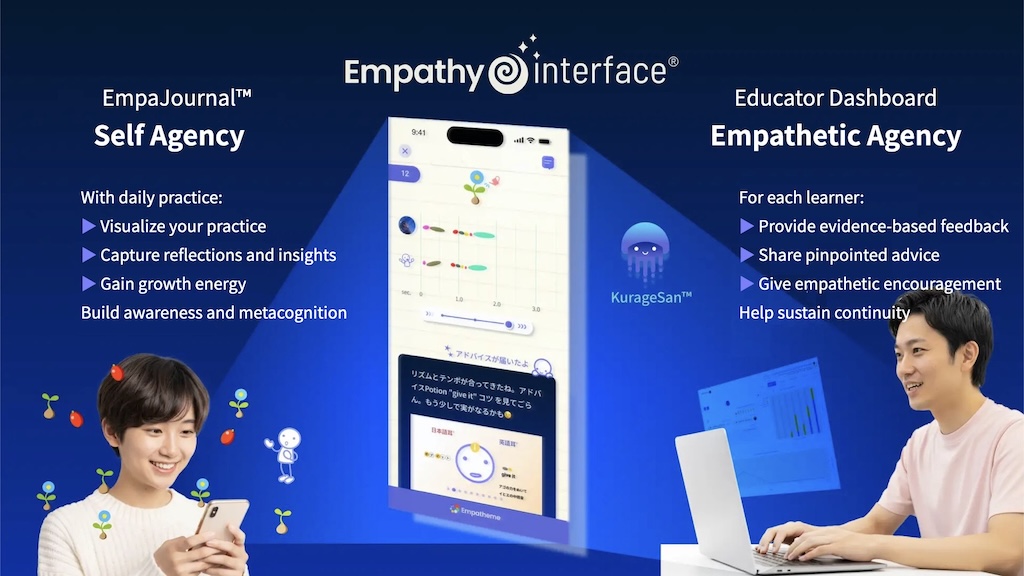
Empathy Interface – Bridging Self-Agency and Empathy
The Empathy Interface seamlessly connects the English Ear° Trail® app and Educator Dashboard. By linking the learner’s practice field—the Empa-Journal—with the Dashboard that observes, supports, and reflects on their progress, a co-creative learning space emerges through their interaction.
Educator Dashboard for Empathetic, Personalized Guidance
The Dashboard can be used by a wide range of English educators, including:
- Teachers, instructors, and coaches
- Cram schools and language schools
- English learning groups
- Online teachers and YouTubers
- Native and non-native tutors
It’s also valuable for formal education (elementary to university) as a supplement to classes and teaching materials, or as a framework for self-study support in listening and speaking. It works alongside existing resources, offering explanatory content and real examples of effective and ineffective practices.
All essential information for supporting learners is visualized on the Dashboard.
When this is combined with your attentive encouragement and empathy, co-creative learning emerges, and learner growth accelerates.
No exceptional experience is required—the dashboard provides everything you need to help your learners grow. When combined with genuine encouragement and attention, it fosters co-creative learning and accelerates learner growth.
The dashboard is currently available on a trial basis for instructors supporting multiple learners, with plans to extend it for personal use by individuals dedicated to their own practice.
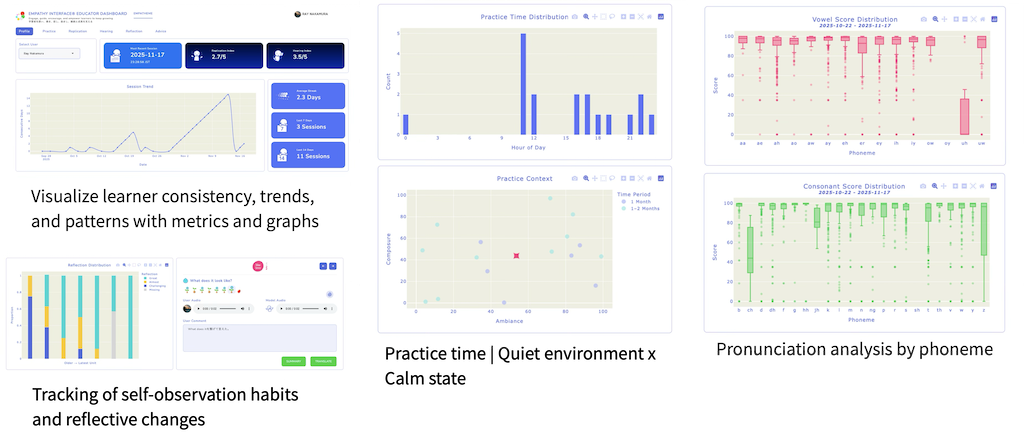
Main Features & Core Technologies
① Visualizing and Shaping Practice
The embedded Empathetic AI “KurageSan®” provides concise summaries of each practice session, highlighting key actions and tendencies.
② Visualizing and Shaping Cognition
Understand the learner’s internal cognitive changes through both summary and detailed analysis of RATIP—Rhythm, Articulation, Tempo, Intonation, Pronunciation.
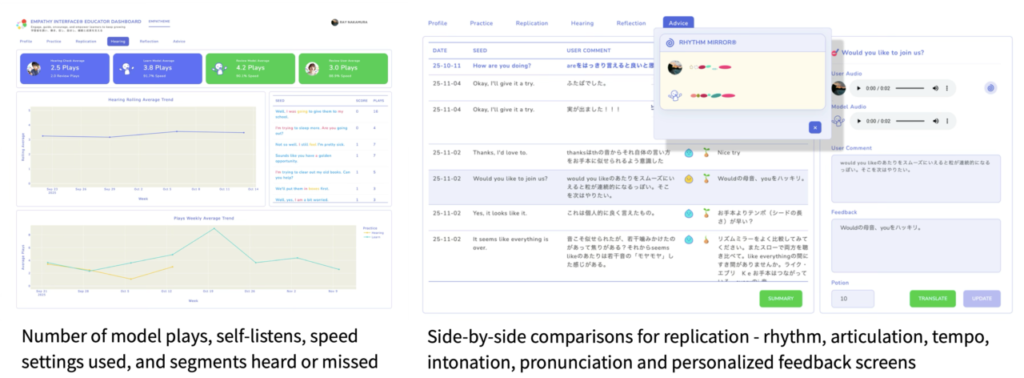
By combining these acoustic indicators with the learner’s self-observation and reflection trends, the Dashboard supports deep insight into evolving cognition.
③ Visualizing and Shaping Communication
Seamlessly connected with each learner’s Empa-Journal, the Dashboard enables inviting, guiding, prompting, encouraging, and supporting the learner through co-creative interaction.
It integrates Rhythm Mirror® displays, voice playback, targeted advice, messaging, and feedback—creating a unified communication interface for learning.
Empatheme Lab – A Field that Opens Co-Creation
Six Months of Tangible, Measurable Growth for Junior and Senior High School Students— Chiyoda Junior & Senior High School
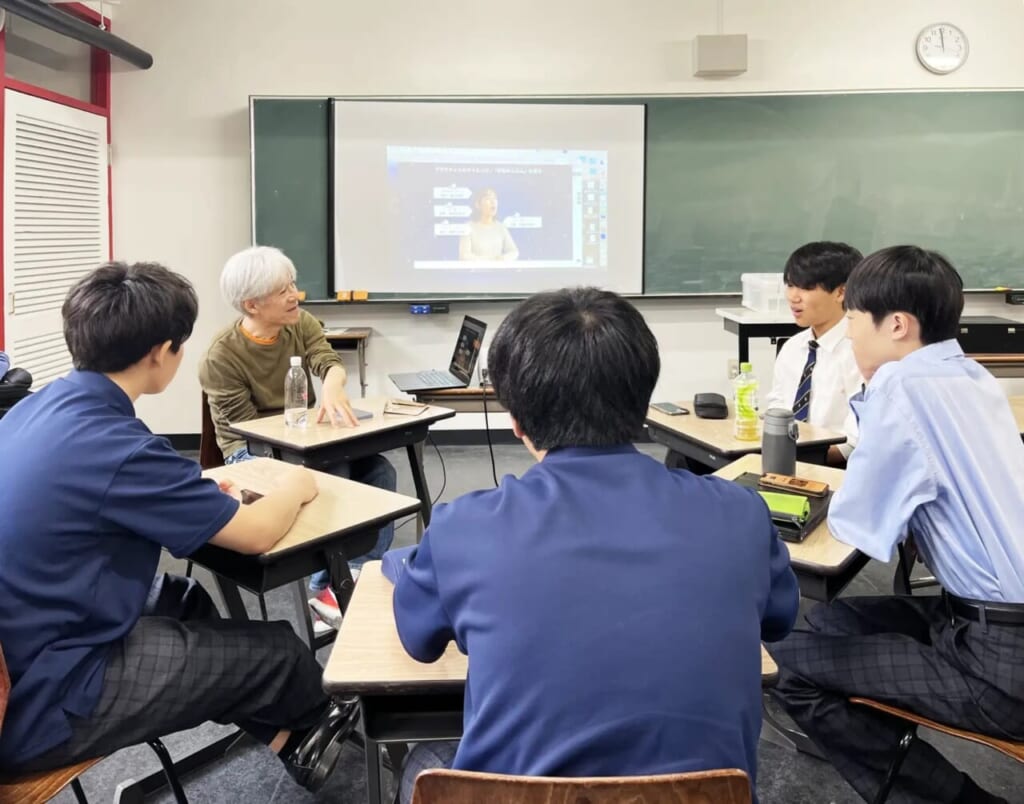
(Photo: The CEO Rikko Sakaguchi and Students Explore Together Every Saturday)
The Empatheme “Co-Creative AI English Ear° Science Lab” isn’t a typical English classroom. Instead, it bridges the science of cognition, speech, and language with daily practice, inviting students into a space for insight and growth.
Students maintain a 15-minute daily routine at home for over six months,
experiencing the joy of nurturing Seeds through reproducibility and the delight of unexpected improvement. As their growth becomes visible, their sense of progress directly fuels daily practice, accelerating improvement.
This journey is documented in the video “Nao’s 100-Day Growth Story,” which showcases his Rhythm Mirror® visualizations and daily practice steps.
Comment from Principal Kenta Kimura, Chiyoda Junior & Senior High School
“In the ‘Co-Creative AI English Ear° Science Lab,’ where Mr. Rikko Sakaguchi—the creator of Sony’s XPERIA—works directly with our first-year students, the results are remarkable. This is clearly shown in their data and growing confidence. It’s a new form of learning that fosters metacognition and self-agency. We are truly grateful and hope to see this initiative spread nationwide.”
Co-Creation with Research Institutions – A New Initiative

Led by our CTO, Hidenori Ishikawa (Visiting Professor at Ritsumeikan University), we are driving next-generation research that integrates analysis of learners’ stress, focus, and practice outcomes. By extracting biometric indicators from voice, we now treat internal cognitive and emotional processes—once considered invisible—as real-time data.
This breakthrough allows us to generate exact, personalized advice rooted in vocal feature data, tailored to learners’ practice results and continuity patterns. By linking bio-responses, cognitive data, and vocal signals, we are building technology that redefines learning and progress in the AI era.
Messages from Those Who Support and Co-Create with Empatheme
Kazushi Ambe (BAKUTAN Advisor, former Sony EVP of Human Resources):
“I am deeply moved by this co-creative approach, which draws out essential human abilities for the AI era. It clearly shows the social value and importance of Mr. Sakaguchi’s passion and holds great potential for future generations to exercise their abilities and co-create with AI fully.”
Katsumi Ihara (Outside Director at Hitachi; former Sony Executive Deputy President):
“Empatheme is an innovative initiative that brings a new data-driven perspective to smartphone use. Rikko’s creativity and leadership are fully reflected. I see great significance in combining visualization technology to unlock human potential with empirical, data-driven methods.”
Masazumi Ishii (President & CEO, AZCA, Inc.; Silicon Valley VC):
“SomniQ stands out as a unique venture with deep resilience from 13 years of R&D. Their fusion of science, the liberal arts, and a commitment to humanity and technology is essential in the AI era, opening new markets and value. I look forward to their continued growth as pioneers.”
Kunitake Ando (Former President & CEO, Sony Corporation):
“I am impressed by SomniQ’s 13 years of cross-border R&D and their key patent portfolio for next-gen learning. This groundbreaking first step—linking the human voice to learning innovation—has global potential.”
Outlook for the First Half of 2026 – New Horizons Opened by Empatheme®
emp – The Practice Energy Coin
Making the Trail Experience More Fun, Rewarding, and Exciting
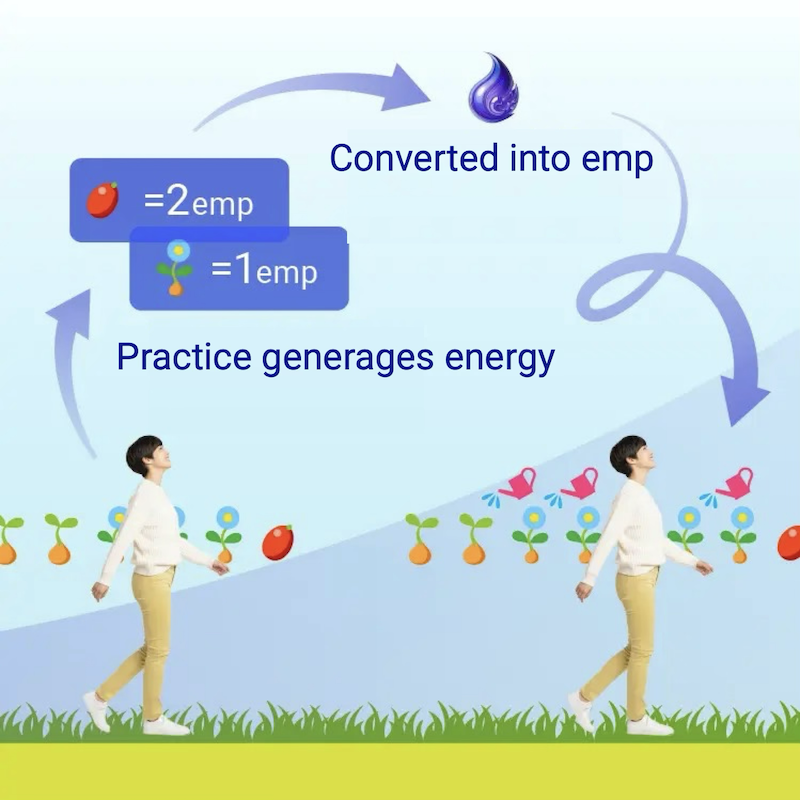
“emp” stands for Empathetic Moment by Practice. It’s a Practice Energy Coin that visualizes the motivation and energy generated by your practice. Circulating within English Ear° Trail®, emp acts as a fuel powering a virtuous circle: Practice → Energy Generation → More Practice.
Earn emp through daily practice and by supporting others. Use emp to:
- Water your Seeds and get advice
- Tackle new challenges
- Deepen your learning
- Support your peers
- Encourage your students
With emp, the Trail becomes more engaging, joyful, and dynamic for everyone involved.
Empathetic AI “KurageSan®” Evolves with Participants
At the core of any AI are machine learning methods grounded in mathematics, statistics, and computer science.
The empathetic AI “KurageSan®,” embedded in the new Empathy🌀 Interface® Dashboard, was created by our Chief Data Scientist, Riu Sakaguchi (Northwestern University, M.S. in Machine Learning & Data Science, 2023).
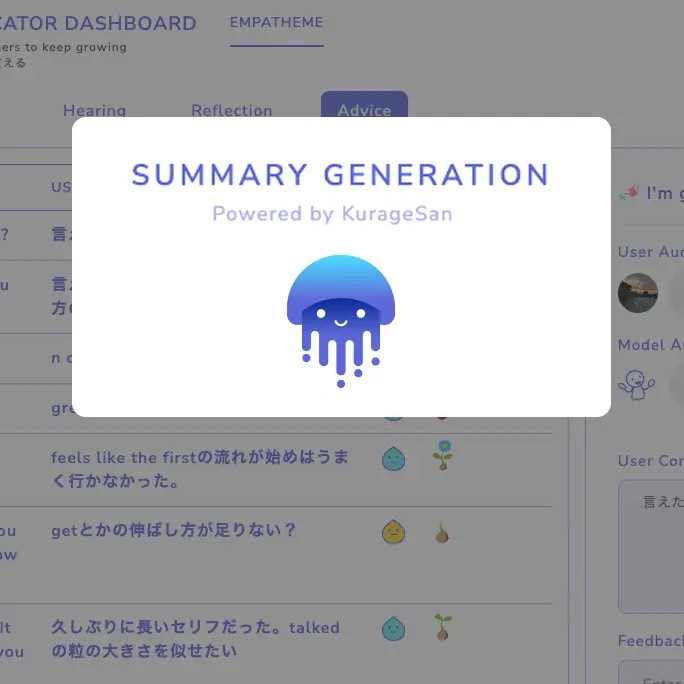
KurageSan® supports Educators and learners by attentively considering each individual’s context.
By integrating Empatheme’s practice data with the Context Mirror®, KurageSan® helps create a new learning environment that co-creates self-agency and empathy among learners, Educators, and researchers.
(Photo: A view of KurageSan® appearing in the dashboard)
KurageSan® is not an AI that returns the same answer to everyone. It offers gentle, precisely targeted guidance—like a softly glowing thread lowered at just the right moment—pointing to what is meaningful and needed right now.
With a humble, steady presence—neither talking down nor deferential—it quietly stays beside you in the vast ocean of knowledge, gently swaying and watching over your practice.
This imagined “Kurage-san®” (Mr. Jellyfish) serves as the model for our Empathetic AI.
Our vision is for KurageSan® to continue evolving together with everyone’s Practice.
The natural behaviors of English Ear° Trail® participants—their Seeds sprouting or not sprouting, their challenges, stumbles, and inner dialogues—will become nourishment that complements existing generative AI and opens new frontiers in learning.
About SomniQ
SomniQ, Inc. (Palo Alto, CA, USA)
Founded on November 10, 2012
CEO: Rikko Sakaguchi
CTO: Hidenori Ishikawa
SomniQ Co., Ltd. (Tokyo, Japan)
Founded on January 4, 2018
CEO: Rikko Sakaguchi
CTO: Hidenori Ishikawa
Vision – Revolutionize Practice. Self-Agency × Empathy through Empatheme®
SomniQ is a Silicon Valley venture with research activities in the United States and Japan. For over 13 years, we have combined science and the liberal arts, putting humanity and technology at the core of our innovation.
Founded in Menlo Park in 2012, SomniQ built a solid R&D foundation before the AI era, creating a portfolio of co-creative method patents—including context feedback, dynamic speech visualization, stationary-state interfaces, empathic response systems, and affordance design.
Our principal technology is the Empatheme🌀 Interface®, a human–AI co-creative practice system centered on the patented Hearing Mirror®, Rhythm Mirror®, and Context Mirror®. These components are seamlessly integrated within a unified Journal–Dashboard platform, providing comprehensive visualization and support for human practice.
In 2018, we began service development in Japan, bringing our technologies from research into real-world applications. This year, we launched English Ear° Trail—a platform that helps learners and educators build daily practice routines and experience English sounds and rhythm in new ways. Our products provide real-time and continuous feedback to encourage consistent, joyful learning.
With Empatheme, practice becomes a living medium for the dynamic interplay of self-agency and empathetic agency. As people practice, their actions, timing, and presence become shared assets, fostering mutual learning and social innovation—and advancing co-creative AI.
SomniQ seeks to lead this new ecology, where practice becomes culture and media itself becomes practice. Built on unique technology, IP, and the power of shared and accumulated practice data, we aim to set a new foundation for learning, content, and value creation through co-creative human–AI practice.